Quick answer: match your chimney flue diameter to your appliance outlet. Most US wood stoves use a 6 inch flue; larger stoves, furnaces and some fireplaces use 8 inch. Never reduce the flue below the size of the appliance collar. If your outlet falls between sizes, follow the manufacturer's stated outlet and size up, not down.
Below is a practical overview of the most common diameters seen in residential and similar small applications. Chimney pipes should have the same diameter as the appliance choutlet, never smaller than the size recommended by the appliance manufacturer.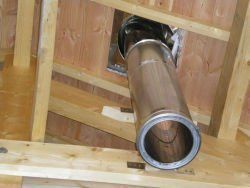
Standard Chimney Flue Diameter: 6 Inch or 8 Inch
In a US home the standard chimney size for a wood stove is a 6 inch flue, and 7 or 8 inch for a large or catalytic stove. Flue pipe size follows the appliance: never go below the outlet size on the stove.
- 6 inch, for a small or medium wood stove. It is the outlet most modern stoves are built with.
- 7 or 8 inch, for a large or catalytic stove.
- 8 inch and larger, for an open masonry fireplace, because that flue is sized from the fireplace opening rather than from an appliance collar.
Our Class A chimney pipe comes in those two sizes, 6 inch and 8 inch, and both come out of one matched system, so every section, tee and support in the run fits the next. Go straight to 6 inch Class A chimney pipe or 8 inch chimney pipe, or open the whole Class A chimney pipe range and pick the diameter there.
Measure the collar on your appliance before you order. If you would rather have the whole run checked first, our flue design service is free: send the stove model, the chimney height and the route through Expert Advice, or call 888-834-0880 and we will size it with you.
Overview Table: US Chimney Sizes by Appliance
| Appliance | Typical diameter (in.) | Vent / chimney class | Governing standard | Notes |
|---|---|---|---|---|
| Wood stove (small / medium) | 6 | Class A, UL 103 HT (2100 F) | NFPA 211 | Most modern EPA stoves are 6 in. outlet. Never reduce below outlet. |
| Wood stove (large / catalytic) | 7 or 8 | Class A, UL 103 HT | NFPA 211 | Common on stoves above ~80,000 BTU or freestanding inserts with large fireboxes. |
| Pellet stove (freestanding) | 3 or 4 | Type L, UL 641 (PL vent) | NFPA 211, manufacturer spec | 3 in. up to ~30 ft total horizontal+vertical, 4 in. for longer runs or higher BTU. |
| Pellet insert / direct vent pellet | 3 (exhaust), with 2 in. fresh air | Type L PL or DV pellet | NFPA 211 | Manufacturer install instructions override generic sizing. |
| Open masonry fireplace | 8, 10, 12, or 13 (round) | Masonry chimney, UL 1777 if relined | NFPA 211 | Flue area = 1/10 of opening for chimneys above 15 ft, 1/8 for shorter chimneys. Rectangular sizes 8x12, 12x12, 12x16 are equivalent to those rounds. |
| Factory built (zero clearance) wood fireplace | 8 to 12 (per listing) | UL 127 | NFPA 211 | Chimney size is fixed by the listing, do not substitute. |
| Gas furnace / boiler, Cat I (atmospheric) | 3, 4, 5, or 6 | Type B, UL 1738 | NFPA 54 | Sized from NFPA 54 vent tables based on input BTU, lateral length, and rise. |
| High efficiency condensing gas (Cat IV) | 2 or 3 (PVC, CPVC, or PP) | Sealed direct vent | NFPA 54, ANSI Z21 / CSA 2.33 | Material per appliance listing, often 2 in. up to 100,000 BTU, 3 in. up to ~199,000 BTU. |
| Gas log set in masonry fireplace | Same as fireplace flue | Masonry, damper locked open | NFPA 211, NFPA 54 | Vented sets require the chimney to remain functional. |
| Gas freestanding stove (vented) | 4 (typical) | Direct vent, coaxial | NFPA 54, listing | Coaxial vent kits, often 4 in. exhaust inside 6 5/8 in. intake. |
| Gas garage heater (unit heater, low intensity) | 4 or 5 | Type B or direct vent | NFPA 54 | 45,000 to 125,000 BTU is the common range, vent per Table 13.2 of NFPA 54. |
| Gas tube heater (low intensity infrared, garage / shop) | 4 (intake and exhaust) | Listed direct vent | NFPA 54, ANSI Z83.20 | Two pipe system, lengths per manufacturer. |
| Oil fired furnace or stove | 5 or 6 | Type L, UL 641 | NFPA 31, NFPA 211 | Some older units vent into Class A masonry. |
| Marine solid fuel stove (boat, e.g. Dickinson, Sigmar) | 3 (most) or 4 | 316 stainless, double wall through deck | ABYC A-7, manufacturer | Through deck fitting and Charlie Noble cap required. |
| Marine diesel heater (forced air, e.g. Webasto, Espar) | About 7/8 to 1 in. exhaust | Stainless flexible, insulated | ABYC A-7 | Forced draft, not natural draft, so they use much smaller flues. |
| Marine diesel cabin heater (gravity, e.g. Refleks, Dickinson) | 3 | 316 stainless double wall | ABYC A-7 | Gravity drip diesel needs full natural draft. |
| Coal stove (anthracite) | 6 | Class A, UL 103 HT | NFPA 211 | Often power vented in basement installs. |
Once you know your size, shop matched sections on our Class A chimney pipe page, or call our US team on 888-834-0880 and we will confirm the diameter for your stove.
Once the diameter is settled, a class a chimney pipe kit brings the matched sections and roof parts together.
Types of chimney flue, in plain terms
For a US wood or solid-fuel appliance there are three flue types you actually choose between:
- Class A insulated chimney pipe is double-wall stainless, UL 103 HT listed for 1000 F continuous, for a brand-new chimney run through a ceiling, wall or roof. Shop it on our Class A chimney pipe page.
- Flexible stainless liner (316Ti) drops inside an existing masonry chimney to reline it, and suits all fuels. See our chimney liner kits.
- Connector (stove) pipe, single-wall or black double-wall, runs only inside the room between the stove and the Class A chimney, never through a wall or ceiling.
Why Each Appliance Needs Its Specific Chimney Size
Wood stoves
Wood produces gas around 400 to 800 F at the appliance outlet, with peak draft demand during cold start and reload. A 6 in. flue balances cross sectional area and gas velocity for the 30,000 to 80,000 BTU range that most modern EPA stoves operate in. Going larger drops gas velocity, the gas cools faster, condensation forms, and creosote builds up on the inside of the chimney. Going smaller restricts the natural draft the stove was tested with, which causes back puffing and incomplete combustion. EPA emissions testing was largely conducted at 6 in., so manufacturers designed their fireboxes around that draft characteristic, which is why the size dominates the market. Our guide explains what a chimney flue is and how it differs from the chimney around it.
Pellet stoves
Pellet stoves are forced draft. A combustion blower pushes flue gas out instead of relying on natural buoyancy, which changes the math completely. A 3 in. PL vent works because the blower creates positive pressure, and the smaller diameter actually helps maintain velocity, which keeps fly ash entrained in the gas stream. Above 4000 ft elevation the air is thinner so the same blower moves less mass, which is why most manufacturers require upsizing to 4 in. The flue must be sealed because the pressure inside is positive, the opposite of a wood stove flue.
Gas appliances
Gas combustion produces lower flue temperatures than wood, around 300 to 500 F for Category I atmospheric units and as low as 100 to 150 F for Category IV condensing units. Cooler gas means less natural buoyancy, which means draft has to come from either height or a fan. Type B vent uses a double wall construction with an air gap to keep flue gas warm enough to draft naturally. Condensing units don't need any of that because they pull combustion air mechanically and exhaust through PVC or polypropylene at near room temperature. PVC is only safe because the gas is cooled below 140 F, which is why you cannot vent a non condensing furnace through PVC even if the diameter matches.
Open fireplaces
A fireplace is a much harder draft problem than a stove because the opening is large, the gas is diluted with room air, and there is no door to control combustion air. The 1/10 area rule comes from decades of empirical testing and is essentially a velocity calculation, with the goal of keeping flue gas moving at a few feet per second so smoke does not roll back into the room. Throat dimensions, smoke chamber shape, and damper position all matter alongside the flue size. Get the flue too small and the fireplace will smoke into the room every time you light it.
Garage and shop heaters
Unit heaters and tube heaters in garages run on natural gas or propane and are typically installed where headroom is at a premium. The 4 or 5 in. vent size is dictated by the BTU input. For a typical two car garage that is 30,000 to 60,000 BTU, and a 4 in. Type B vent handles up to about 75,000 BTU on a short run. Tube heaters are different because they are radiant and the flue gases stay much cooler in the radiant tube, so the manufacturer's two pipe direct vent kit is mandatory.
Marine stoves
On a boat the flue has constraints that don't exist on land: tight space, motion, salt corrosion, and the requirement that the Charlie Noble keeps water out in any weather. The 3 in. standard for marine solid fuel and gravity diesel is the largest size that can pass through a typical deck thickness with proper insulation, while still giving enough draft for the small fireboxes used on boats. Forced air diesel heaters from Webasto and Espar use very small exhaust pipes because they are fan driven and the BTU output is modest, typically 5,000 to 14,000 BTU.
Oil stoves and furnaces
Oil burners run hot, around 400 to 600 F, but produce more soot than gas. The 5 or 6 in. Type L flue gives enough cross section to handle that soot without rapid clogging, and the L rating means the vent can survive a flue fire if the soot ignites. NFPA 31 governs oil installations because they have unique fire and spill considerations not covered by NFPA 211 alone.
Standards You Will See Cited
NFPA 211 covers chimneys, fireplaces, vents, and solid fuel burning appliances. NFPA 54, also published as ANSI Z223.1, is the National Fuel Gas Code and contains the vent sizing tables for Category I gas appliances. NFPA 31 covers oil. UL 103 lists Class A residential chimneys, with the HT suffix meaning tested to 2100 F for solid fuel. UL 103 without HT is for oil and gas only. UL 1777 covers chimney liners. UL 641 covers Type L low temperature vents used for oil and pellet appliances. UL 1738 covers Type B gas vents. UL 127 covers factory built fireplaces. For boats, ABYC A-7 (Boat Heating Systems) is the recognized standard, and US Coast Guard CFR 46 applies for inspected vessels.
Practical Sizing Rules
Solid fuel
Never reduce the flue below the appliance outlet, and avoid going more than one nominal size larger, since an oversized flue cools the gases and weakens draft. Total vertical height should be at least 15 ft from appliance to cap for natural draft wood and pellet, and the cap must follow the 10-2-3 rule explained below.
Gas
For Category I appliances, sizing comes from the NFPA 54 common vent and single appliance tables, which require the input BTU, the lateral run, and the total vertical rise. For Category IV condensing equipment, you size to the manufacturer instructions, which override the code tables. Maximum equivalent length is usually expressed in feet of straight pipe, with each 90 degree elbow counting as 5 ft.
Open masonry fireplaces
The rule of thumb is flue cross sectional area equal to one tenth of the fireplace opening for chimneys 15 ft and taller, and one eighth for shorter chimneys. A 36 by 29 in. opening (1044 sq. in.) needs roughly 104 sq. in. of flue, which a 12 by 12 in. clay tile or a 13 in. round liner will satisfy.
Pellet
Manufacturers publish a maximum equivalent length table in the manual. A common limit is 30 ft of equivalent run on 3 in. PL vent, then upsize to 4 in. for longer runs. Above 4000 ft elevation most makers require 4 in.
Marine
The through deck fitting, the deck iron, and the Charlie Noble must all match the flue diameter, and all penetrations need a deck collar rated for the temperatures involved. ABYC A-7 also requires a fresh air supply for any combustion appliance below decks.
How to measure your existing flue
For round metal flues, measure the inside diameter with a tape across the top of the chimney or at the appliance connection. Measure twice and average. For rectangular masonry tile, measure the inside dimensions of the clay tile and multiply, then compare that area to the round equivalent. A 12 by 12 in. tile has 144 sq. in. of cross section, which corresponds roughly to a 13 in. round flue. An 8 by 8 in. tile has 64 sq. in., or about a 9 in. round equivalent. If the chimney is masonry without a liner you cannot just measure the brick opening, because the flue dimension is the inside of the tile or liner, not the chase. Drop a tape down from the top to confirm. If you find no liner, the chimney needs to be lined before any modern appliance can be connected.
Chimney height and draft
Draft is the pressure difference between the bottom and top of the chimney that pulls flue gas upward. It is created by the temperature difference between the flue gas and outside air, multiplied by the height of the column. Doubling the height doubles the draft, all else being equal. That is why a 30 ft chimney out drafts a 15 ft chimney even with the same diameter and the same fire. Minimum heights are 15 ft total for wood and pellet, NFPA 54 vent table dependent for gas Category I (often 5 ft minimum vertical rise above the connection), and 15 ft from hearth to cap for an open fireplace as a practical minimum. If a chimney does not meet these heights, draft will be marginal in mild weather and the appliance will smoke or backdraft. Adding height is usually cheaper than chasing other fixes.
The 10-2-3 rule
The cap of a chimney must be at least 3 ft above the highest point where it passes through the roof, and at least 2 ft higher than any roof, wall, or structure within 10 ft horizontally. This prevents downdrafts caused by wind eddies on the leeward side of nearby roof peaks, dormers, or trees. It applies equally to wood, pellet, gas, and oil chimneys, and is enforced by NFPA 211 and most building codes. Field example: a chimney that exits a roof slope 4 ft below the peak needs to extend at least 6 ft above the roof penetration to clear the peak by 2 ft, since the peak is within 10 ft horizontally. Using only the 3 ft minimum without checking the 2 ft rule is the most common installer mistake.
When you need a power vent or induced draft fan
Natural draft fails when the chimney is too short, the lateral run is too long, or the gas is too cool to rise on its own. A power vent (solid fuel) or induced draft fan (gas) then creates draft mechanically. Common scenarios are pellet stoves below grade where the vent run goes up through a basement wall, gas appliances in modern tight homes where stack effect competes with the flue, long horizontal sideline runs that exceed the natural draft limit, and multiple appliances sharing a chimney where one is condensing. Power vents add cost ($400 to $900 for the unit plus install), require electrical power, and need an interlock so the appliance cannot fire if the fan is not running. NFPA 211 and NFPA 54 both require listed power vents matched to the appliance category.
Single wall, double wall, and triple wall stove pipe
Inside the room, between the appliance and the ceiling, you use stove pipe, not chimney. Stove pipe is connector pipe, not chimney rated. Single wall black stove pipe is the cheapest, runs hot on the outside, and requires 18 in. clearance to combustibles. It works for tall ceilings and large rooms. Double wall stove pipe (insulated or air gap construction) requires 6 in. clearance to combustibles and is mandatory in alcoves or low ceiling installations. Brands include DuraVent DVL and Selkirk DSP. Triple wall is typically reserved for the chimney portion where it passes through walls, ceilings, and roofs, where it is called Class A chimney. Class A uses a 2 in. clearance to combustibles and is the only product allowed for the chimney portion above the ceiling. The transition from stove pipe to Class A happens at the ceiling support box or wall thimble. Never run stove pipe through a wall or ceiling.
Flue liner materials
Clay tile is the traditional masonry liner, cheap, fire resistant, but rigid and prone to cracking from thermal shock or seismic movement. A cracked clay liner is a fire hazard. Stainless steel 304 is the standard upgrade liner for wood, pellet, and gas, and handles temperature cycling well in dry conditions. Stainless steel 316Ti or AL29-4C is required for high efficiency gas (Category IV) and oil applications because the condensate is acidic. Using 304 in those conditions causes pitting and failure within a few years. Pumice liners are a European product occasionally seen in the US, lightweight and high insulating, popular in masonry rebuilds. Insulated stainless liners (poured vermiculite or wrapped ceramic blanket) are the gold standard for wood: the insulation keeps gas hot, draft strong, and reduces creosote.
Common Flue Sizing Mistakes
Many people make a few common mistakes when trying to find the appropriate flue size. Two main ones are listed below.
Oversized flues
People often think that bigger is better. With chimney flues you want it to fit well within the size range for the appliance. An oversized flue can cause:
- Insufficient heat retention
- Lack of velocity
- Inefficient airflow
- Difficulty maintaining consistent temperature
- Reduced stack effect
Undersized flues
A flue that is too small hampers the system from working properly. The consequences include:
- Limited airflow
- Inadequate draft
- Increased back pressure
- Smoke spillage
- Creosote accumulation
Can a Chimney Flue Be Too Big?
Yes, and it is the easier mistake to make. One nominal size above the appliance outlet is the practical limit, and that step wants a transition cone at the appliance.
A flue wider than that lets the smoke slow down and cool on the way up, so the draft weakens and creosote settles instead of leaving.
An old masonry chimney is usually far wider than one size up. A 6 inch stove into a 12 inch masonry flue is not something to live with: line the chimney down to the stove's own diameter with a stainless chimney liner kit sized to the appliance, and the draft comes back.
Typical Installation Costs and Timeline
Costs vary by region and installer, but the following ranges are typical for a straightforward US install in 2026.
- Wood stove plus stove pipe and Class A chimney through a single story roof: $3,500 to $7,000 installed.
- Pellet stove plus PL vent through a sidewall: $1,500 to $3,500 installed.
- Direct vent gas stove or insert: $2,500 to $5,500 installed.
- Open masonry fireplace relining with insulated stainless: $2,500 to $5,500 depending on chimney height and condition.
- Gas furnace Category IV PVC venting (replacing old Cat I with new Cat IV): $1,000 to $2,500 in venting work, separate from the furnace cost.
- Marine diesel cabin heater install with deck fitting: $1,500 to $3,500 in materials, plus labor that is highly yard dependent.
Most jobs take a single day for a competent installer. Two days is realistic if a chimney chase needs to be built or a roof penetration framed.
Frequently Asked Questions
Can I reduce my chimney pipe size to fit my new stove?
No. The chimney must equal or exceed the appliance outlet diameter. Reducing the flue restricts draft and can cause back puffing, excess creosote, and smoke spillage. If the chimney is too large, line it down, never reduce the connector.
Can I increase the chimney size if my chimney is bigger than my stove outlet?
Only by one nominal size, and only with a transition cone. A 6 in. stove into an 8 in. chimney is borderline acceptable in tall chimneys. A 6 in. stove into a 12 in. masonry flue should be lined down to 6 in.
Does chimney diameter affect efficiency?
Yes. Oversized flues cool the gas, condensate forms, and combustion efficiency drops. Undersized flues restrict airflow, cause incomplete combustion, and waste fuel. The right size keeps flue gas hot enough to maintain draft while exhausting completely.
What is the difference between Class A and Type B?
Class A is solid fuel rated chimney, tested to 2100 F continuous and 2100 F flue fire (UL 103 HT). Type B is gas vent only, tested to 540 F (UL 1738). Type B will fail in a wood fire. Never use Type B for wood.
Can I use the same chimney for two appliances?
NFPA 211 allows multiple solid fuel appliances on one flue only in very specific cases, and most jurisdictions prohibit it. NFPA 54 allows common venting of multiple Category I gas appliances if sized per the common vent table.
Is PVC really safe for furnace exhaust?
Yes, but only for Category IV condensing furnaces where the flue gas is below 140 F. PVC has a UL listing for that purpose. Never use PVC for any appliance hotter than 140 F flue gas.
How often should I sweep my chimney?
Wood: at least once per heating season, or every cord of wood burned. Pellet: annually. Gas: inspect annually, sweep rarely needed. Oil: annually because of soot buildup.
Do I need a permit to install a stove or fireplace in the US?
In almost all US jurisdictions, yes. Solid fuel appliance installation requires a building permit, often a mechanical permit, and inspection. Insurance may also require proof of permitted install for coverage to apply.
Conclusion
This US flue size chart helps you make an appropriate choice when sizing a new chimney flue. Picking the right size makes the difference between a system that runs efficiently and one that barely works. Beyond the flue diameter, the chimney height, the liner material, the connector pipe wall type, and compliance with the 10-2-3 rule all influence draft and safety. Another useful step in many older homes is installing an insulated stainless steel chimney liner, which protects a brick and mortar chimney from the corrosive effects of combustion gases and improves draft on long cold runs.
If you are in doubt, the cheapest mistake is to call a NFI certified sweep or your local building department before buying parts. The most expensive mistake is to size by guesswork, install, and discover the appliance smokes, drafts poorly, or fails inspection.
Caveat. Always check the appliance listing and the manufacturer install manual first. The numbers above are typical, but a UL listed appliance is only legal to install per its listing, and that overrides any general table.