Ready to reline your chimney? Build your insulated chimney liner kit and add the matching insulation in a few clicks. We size it to your liner automatically.
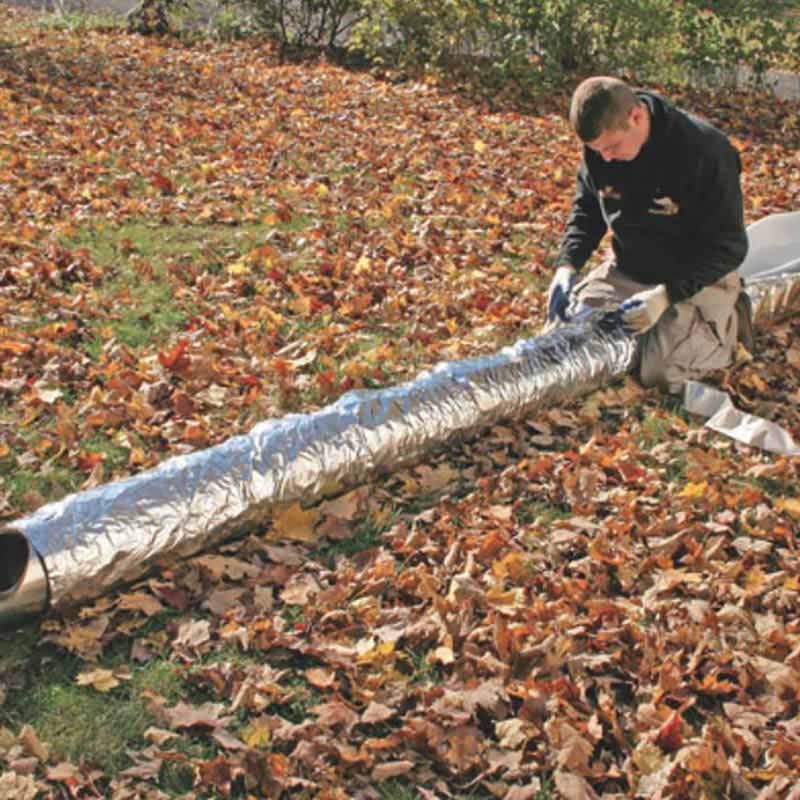
Why insulating a chimney liner matters
A wood stove outlet is small, but a masonry chimney flue is usually much larger. That leaves a big air gap around the liner. Without insulation, the flue gases cool down quickly as they rise. Cooler gases mean a weaker draft and far more creosote, the sticky, flammable residue that builds up inside the liner. Creosote is the leading cause of chimney fires.
An insulation wrap keeps the flue gases hot all the way to the top. The result is a stronger, more reliable draft, a cleaner-burning stove, and much less creosote, so the system is both safer and easier to maintain. An insulated liner also warms up faster, which helps the stove light and reach temperature more easily, especially on an exterior chimney.
When is insulation required, and when is it just recommended?
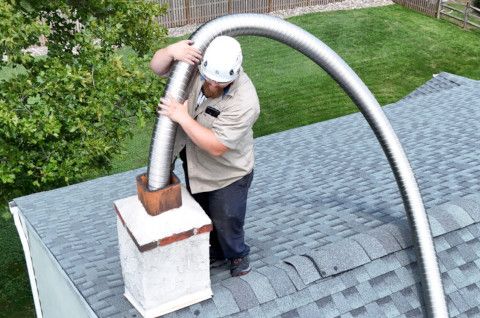 Insulation keeps the flue gas hot, which is what keeps the draft steady and the flue dry. It is normally needed when:
- the joists or floorboards sit hard against the brickwork with no gap;
- the original clay tiles are cracked, missing, or the flue is unlined;
- the chimney sits on an outside wall, where heat is lost fastest;
- your local code or installer follows NFPA 211 for solid-fuel relining.
That first case is the one where insulation is not optional: an insulated liner is what the UL 1777 listing covers for a chimney with timber against it.
Even where it is not strictly required, insulation is strongly recommended for wood and coal because of the draft and creosote benefits above. It can also be a condition for the liner's warranty to remain valid. If your installer has confirmed it is not needed for your specific chimney, you can leave it out.
Which liners need insulation: wood and coal vs gas and pellet
The simplest rule follows the fuel and the liner size:
- 5, 5.5 and 6 inch liners are used for wood and coal stoves. These run hot and dirty, so an insulated chimney liner is the default choice.
- 4 inch liners are used for gas, oil and pellet appliances. These burn cooler and cleaner, so insulation is normally not required.
That is why we offer the matching insulation as an option on our 5, 5.5 and 6 inch wood stove liner kits. If you are still working out which liner belongs in your chimney at all, see chimney liner types compared.
Insulation kit or insulation blanket: which to choose
There are two ways to insulate a flexible chimney liner, and both use the same 1/2 inch thick, 8 lb density insulation, wrapped along the full length of the liner.
- Sized insulation kit. A ready-to-fit Super Wrap kit that matches a specific liner diameter and length. It is the easiest option when your size is available, because it is cut to the right length.
- Universal insulation blanket (FlexWrap roll). A roll of 1/2 inch thick, 24 inch wide, 25 foot long insulation that fits any diameter and length. You wrap it around the liner and secure it. One roll covers up to 25 feet of liner; use a second roll for longer runs.
For a smooth installation we also recommend a pulling nose cone in the matching diameter. It fits over the end of the liner and protects the liner and the insulation while you pull it down through the chimney.
How an insulated chimney liner is installed
In short: lay the liner out straight and fit the bottom connector, wrap the insulation around the full length with the foil side out, seal the seam with foil tape, secure the supplied mesh with banding, fit the pulling cone, and draw the insulated liner through the flue in one steady motion. Make sure the masonry flue is wide enough for the liner plus the insulation, and that the insulation runs the entire length.
Frequently asked questions
Do I always need to insulate a chimney liner?
No. For wood and coal it is usually required or strongly recommended. For gas, oil and pellet it is normally not needed. The deciding factors are the fuel, the condition of the chimney, and your local code.
What thickness of insulation does a chimney liner use?
A 1/2 inch (13 mm) thick, 8 lb density blanket is standard, wrapped around the full length of the liner. It has to cover the full length, because a gap leaves a cold spot.
Does an insulated liner improve draft?
Yes. By keeping the flue gases hot, an insulated liner draws more strongly and consistently, which also means less creosote and easier lighting, especially on cold or exterior chimneys.
Can I insulate a liner myself?
Yes. Both the sized insulation kit and the universal blanket are designed for DIY installation, and a matching pulling cone makes the job easier.
Build your insulated chimney liner kit. Choose your diameter and length, add the matching insulation, and we will size it to your liner automatically. Start your chimney liner kit.
Need more information?
If you are not sure whether your chimney needs an insulated liner, about the difference with a flue, or which insulation size to choose, contact us and we will help you put the right kit together for your stove and chimney.