Most people meet this decision the same way: a sweep looks up the chimney, says the lining has failed, and suddenly there are four words on a quote you have never heard before. Here is what the options actually are and which one belongs in your house.
Whichever liner you have, it needs an annual inspection: our chimney and flue cleaning guide explains when to sweep and how the brush changes by flue type.
The Liner Types You Actually Choose Between
Flexible stainless steel is the workhorse. It is a corrugated tube that bends down an existing masonry chimney, including one with offsets, and it is what we supply for wood-stove relines in 316Ti stainless. Rigid stainless is straight sectional pipe, simpler to manufacture but only usable in a perfectly straight flue with no bends. Clay tile is the original lining in most older masonry chimneys, laid section by section as the chimney was built, and it cracks with age and heat cycling. Cast-in-place is a poured cement lining, a specialist repair we do not supply.
If you are relining for a wood stove, the practical choice is flexible stainless. It handles the bends, it goes in from the top in a day, and it is the only one of the four you can realistically fit yourself.
| Liner type | Best for | Handles bends? | DIY-friendly? |
|---|---|---|---|
| Flexible 316Ti stainless | Wood-stove relines, any masonry chimney | Yes | Yes |
| Rigid stainless | Perfectly straight flues only | No | Sometimes |
| Clay tile | Original masonry lining, usually the thing being replaced | No | No |
| Cast-in-place | Specialist masonry repair (we do not supply) | Yes | No |
Why 316Ti Stainless Is the Grade to Look for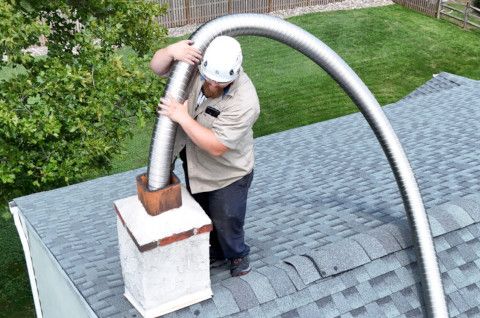
Our flexible chimney liners are 316Ti stainless, which suits all fuel types including wood, and they carry a UL 1777 listing. Wood smoke is acidic and full of moisture when it cools, so the grade matters more than the thickness. 316Ti holds up to that acid attack where lesser grades pit and fail. These liners are made in the USA.
What Size Chimney Liner Do I Need
Match the liner to your appliance outlet, not to the size of the masonry flue it goes inside. Most US wood stoves use a 6 inch liner, and the live US liner categories also include 5 inch systems for compatible smaller appliances. Size from the appliance outlet and listing; do not infer a diameter from the chimney opening alone. Never neck the liner down below the diameter of the stove collar, because an undersized flue chokes the draft and pushes smoke back into the room.
How Long Does a Chimney Liner Last
A 316Ti stainless liner burning seasoned wood in a correctly sized flue is a long-term component, not a consumable, and our liner kits carry a limited lifetime warranty. What shortens a liner is predictable: burning wet wood, an oversized flue that never gets hot enough to stay dry, or a chimney that lets rain in at the top. Clay tile, by contrast, is what fails and sends people looking for a reline in the first place.
Chimney Flue Liner Installation: What the Job Involves
The liner feeds down the chimney from the top, connects to the appliance at the bottom through a tee or an appliance connector, and is sealed at the top with a top plate and rain cap. Insulation wrap goes around the liner where the chimney runs through cold space or an unused flue, because a warm liner drafts better and builds far less creosote. A capable homeowner can install a liner kit; the warranty requires only that the system is installed according to the supplied instructions.
Insulated or Not
Insulate when the chimney is exterior, oversized, or serving a stove you will run hard all winter. The wrap keeps flue-gas temperature up, which keeps the draft steady and keeps moisture and creosote from condensing on the liner wall. In a warm interior masonry chimney of roughly the right size, an uninsulated liner is often fine. Our chimney liner insulation guide sets out when it is needed.
How Do I Know If My Chimney Needs a Liner?
Five signs mean yes. Pieces of clay tile or flakes of debris turning up in the firebox or at the clean-out; a smoke smell in the room when nothing is lit; damp patches or staining on the chimney breast; a draft that is weak or reverses on cold days; and creosote coming back much faster between sweeps than it used to. Connecting a new stove to an older masonry chimney is the sixth reason, and the most common one: a modern stove needs a flue sized to it, and an old flue is almost always too large.
What Are the Common Problems with Chimney Liners, and How Often Do They Need Replacing?
There is no fixed service life stated here: condition, installation, fuel and maintenance all matter. A sweep and inspection can identify creosote, corrosion, damaged components or a sizing problem before they become a safety issue. The problems that shorten one are all avoidable: burning wet wood, which coats the liner in acidic creosote; an oversized flue that never gets hot enough to stay dry; rain entering at the top because the cap or top plate has failed; and an uninsulated liner in an exterior chimney, where the flue gas cools and condenses on the way up.
What are the signs of a damaged liner?
Flakes or fragments of metal at the clean-out, rust staining below the appliance connection, a draft that has changed for no other reason, and visible pitting on a camera inspection. Any of those means an inspection before the next heating season, not after it.
What maintenance does a liner need?
One sweep and one visual inspection a year. That is the whole schedule. Use a poly brush sized to the liner diameter, never a wire brush, because wire scores the stainless wall. Keep the rain cap in place and the top plate sealed: water does more long-term damage to a liner than heat does.
What Does a Chimney Liner Cost, and What Codes Apply?
Our complete flexible 316Ti liner kits start at $559 with free shipping. The final system price depends on the verified diameter, liner length, connector and whether insulation is required, and current prices for every kit are listed on the chimney liner kits page. For an installed total, ask a qualified installer for a written quote based on chimney condition and site access.
On codes, two things matter. The liner itself should carry a UL 1777 listing, which is the standard for chimney lining systems. Per NFPA 211 (Standard for Chimneys, Fireplaces, Vents, and Solid Fuel-Burning Appliances), chimney installations must follow defined clearances to combustibles, minimum height above the roof penetration, and material requirements for the fuel type. Local codes typically adopt NFPA 211 by reference. Check whether your jurisdiction requires a permit before you start, because many do for a change of appliance.
Not Sure Which Liner Your Chimney Takes?
Send us your flue size, appliance outlet and chimney height and our free flue-design service will spec the exact kit, including the tee, top plate and cap. You can also call our US team on 888-834-0880 and we will size it with you on the phone.
Need More Information?
- Chimney and stove pipe FAQ for clearances, temperatures and codes.
- Wood stove pipe installation guides for step-by-step help.
- Talk to our US technical team about your own layout.