Reviewed by Michael Janssen, Chemical Engineer (by training)
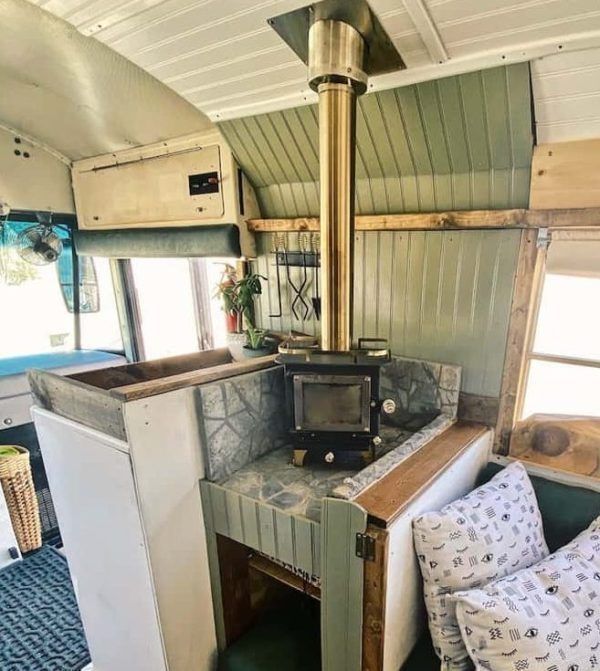
Short answer: the black stove pipe stops at the ceiling or wall, and Class A chimney pipe takes over from there. They join at a support box (a ceiling support box going up, or a wall thimble going out), never in the middle of the framing.
This is the one spot in a wood stove install that trips people up, and it matters for safety, not just tidiness. Black stove pipe and Class A pipe are two different products with two different jobs, and the handoff between them has to happen at exactly the right place.
Two pipes, two jobs
The black pipe coming off the top of your stove is the connector pipe (also called stove pipe). It lives entirely inside the room. It is single-wall or double-wall, and it is not built to pass through a wall, ceiling, or roof.
Class A insulated chimney pipe is the part rated to travel through the building and outside. The moment the run needs to leave the room, the connector pipe ends and Class A begins.
The connection point
| Your run goes | Where they meet | The part that joins them |
|---|---|---|
| Straight up through the ceiling | At the ceiling | A ceiling support box (anchor plate) that holds the Class A and accepts the stove pipe below it |
| Horizontally out through a wall | At the wall | A wall thimble and a tee, then Class A rises up the outside |
Below that support, you have stove pipe. Above it or beyond it, you have Class A. A stove pipe adapter makes the actual joint, sealing the connector into the Class A so the two lock together as one system.
The clearances that decide your layout
Getting the connector clearances right is what keeps the room safe:
- Per NFPA 211, single-wall stove pipe (the connector pipe inside the room between the appliance and the Class A chimney) must maintain at least 18 inches of clearance from any combustible wall, ceiling, or framing.
- Per NFPA 211, double-wall stove pipe is rated for reduced clearances typically 6 inches from combustible walls and 8 inches from ceilings (verify exact clearance with the specific UL-listed product).
That is why many installs use double-wall connector pipe near the ceiling: it lets the stove sit closer to the wall while staying inside code. Once you cross into the ceiling or wall, Class A clearance rules take over instead.
A simple rule to plan by
Never let stove pipe pass through anything structural. If a piece of pipe needs to go through a ceiling, a wall, an attic, or the roof, that piece must be Class A. If it is inside the room in open air, it can be stove pipe. Mark the ceiling or wall as your changeover line and everything downstream falls into place.
Get the transition specced for your room, free
The parts list for this joint depends on your ceiling height, your stove, and whether you are going up or out. Send us your layout and get free flue-design help: we mark exactly where the changeover lands and list every part in the right order. Prefer to talk it through? Call 888-834-0880 and a chimney specialist will size it with you. When you are ready, the matched Class A chimney pipe range carries the support boxes and adapters you need.
Frequently asked questions
Can stove pipe go through the ceiling if I keep the clearances?
No. Clearances let stove pipe run near combustibles inside the room, but the piece that penetrates the ceiling must always be Class A in a support box.
What holds the Class A pipe up at the ceiling?
A ceiling support box (anchor plate) fixed to the framing. It carries the weight of the chimney above and accepts the stove pipe below.
Do I need a different setup for an outside wall exit?
Yes. Going out through a wall uses a wall thimble and a tee, then Class A rises up the exterior. Our Class A chimney pipe guide shows both routes.
Need More Information?
Visit our FAQ, browse the stove pipe installation guides, or check our technical advice section.