The 3-2-10 Rule Explained
The 3-2-10 rule comes from NFPA 211 (the National Fire Protection Association's standard for chimneys, fireplaces, and solid fuel-burning appliances) and is adopted by most local building codes across the United States. It has three parts:
| Rule | What it means | Why it matters |
|---|---|---|
| 3 feet minimum | The chimney must rise at least 3 ft above the high side of the roof where it penetrates | Keeps hot embers away from roofing materials and provides basic draft height |
| 2 feet above | The chimney top must be at least 2 ft higher than anything within a 10 ft horizontal radius | Prevents wind turbulence from nearby roof surfaces or structures from pushing smoke back down |
| 10 feet horizontal | The 2-foot clearance applies to any structure within 10 ft measured horizontally from the chimney | Covers the roof ridge, dormers, adjacent walls, and any nearby structure that could cause downdraft |
Both conditions must be met. On a steep roof where the chimney exits near the ridge, the 2-foot-above rule usually determines the final height. On a shallow-pitched roof where the chimney exits far from the ridge, the 3-foot minimum is often the controlling factor.
How to Calculate the Height of Your Chimney Pipe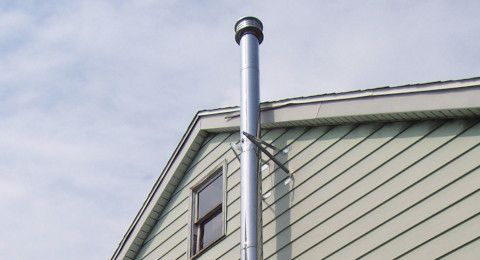
You need two measurements to calculate how much chimney pipe extends above your roof: your roof pitch and the horizontal distance from the chimney penetration to the nearest high point (usually the ridge).
Step 1: Determine your roof pitch
Roof pitch is expressed as rise over run - inches of vertical rise per 12 inches of horizontal run. A 6/12 pitch means the roof rises 6 inches for every 12 inches it runs horizontally. If you do not know your roof pitch, you can measure it from inside the attic with a level and tape measure, or use our roof pitch measurement guide.
Step 2: Measure the horizontal distance to the ridge
From where your chimney will exit the roof, measure the horizontal distance to the roof ridge (the peak). You can usually do this from inside the attic. If the ridge is more than 10 feet away, you only need to measure 10 feet - because the 3-2-10 rule only looks at structures within a 10-foot horizontal radius.
Step 3: Calculate the required height
Multiply your roof pitch rise by the horizontal distance (in feet), then add 24 inches (the 2-foot clearance). The result is how high the chimney cap must be above the roof surface on the uphill side of the penetration.
Here are some worked-out examples for common roof pitches:
| Roof pitch | Distance to ridge | Roof rise at that point | Add 2 ft clearance | Required height above roof |
|---|---|---|---|---|
| 4/12 | 10 ft | 40 in (3 ft 4 in) | + 24 in | 64 in (5 ft 4 in) |
| 6/12 | 8 ft | 48 in (4 ft) | + 24 in | 72 in (6 ft) |
| 7/12 | 4 ft | 28 in (2 ft 4 in) | + 24 in | 52 in (4 ft 4 in) |
| 8/12 | 10 ft | 80 in (6 ft 8 in) | + 24 in | 104 in (8 ft 8 in) |
| 10/12 | 6 ft | 60 in (5 ft) | + 24 in | 84 in (7 ft) |
Always compare your calculated height to the 3-foot minimum. If the calculation gives you less than 36 inches (3 feet), use 36 inches instead. The higher number always wins.
For a more detailed walkthrough with diagrams, see our full article on required chimney height above the roof.
What About the 15-Foot Minimum Total Height?
Most wood stove manufacturers require a minimum total chimney height of 15 feet, measured from the stove's flue collar to the top of the chimney cap. Some manufacturers include the stove pipe (connector pipe) in this measurement, others do not - always check your stove's installation manual.
This 15-foot minimum is separate from the 3-2-10 rule. You need to meet both. In a single-story home with 8-foot ceilings, hitting 15 feet of total height is usually straightforward. In a basement installation or a home with very low ceilings, you may need to plan your chimney route carefully to reach the minimum. Our guide to installing a chimney pipe through the house covers these scenarios in detail.
Where Should the Chimney Exit the Roof?
The location where your chimney penetrates the roof directly affects how much pipe you need above the roofline. Here is a quick comparison:
| Penetration location | Height above roof | Pros | Cons |
|---|---|---|---|
| Near the ridge (high on roof) | Less pipe needed (typically 3-4 ft) | Shorter exposed pipe, cleaner look, easier to brace | Longer internal pipe run from stove to roof |
| Mid-roof | Moderate (4-6 ft typical) | Good balance of internal and external run | May need roof brace if above 5 ft exposed |
| Near the eave (low on roof) | More pipe needed (could be 6-10+ ft) | Shorter internal run, simpler ceiling penetration | Tall exposed pipe, requires roof brace, higher wind exposure |
Whenever possible, plan the chimney to exit near the ridge. This minimizes the amount of exposed pipe above the roof, reduces the need for bracing, and gives the cleanest appearance. If your stove is positioned directly below or near the ridge, a straight vertical run through the ceiling and roof is the simplest installation. Our through-the-attic installation guide walks through this approach step by step.
For that straight run, our chimney pipe through roof kit is built on the page, so you add the sections your height calculation asks for.
What Happens If Your Chimney Is Too Short?
A chimney pipe that does not meet the 3-2-10 rule will cause problems. Some show up immediately, others develop over time:
- Poor draft and smoke spillage - the chimney cannot generate enough upward pull, so smoke backs up into the room when you open the stove door or during startup
- Chronic downdrafts - wind hitting the roofline creates turbulence that pushes air down into a too-short chimney, bringing smoke and cold air into the house
- Increased creosote buildup - poor draft means cooler flue temperatures, which causes more smoke to condense as creosote inside the pipe
- Fire risk from embers - a short chimney puts the top of the pipe closer to the roof surface, increasing the chance that a hot ember lands on shingles, leaves in the gutter, or nearby combustible material
- Failed inspection - a chimney that does not meet code will fail a building inspection, which can block a home sale or void your homeowner's insurance
If your existing chimney is too short, the fix is usually straightforward: add chimney pipe sections to reach the required height. For Class A insulated chimney pipe, you simply add more pipe lengths on top of the existing system. If the chimney extends more than 5 feet above the roof, you will need a roof brace kit to keep it stable in high winds.
What Happens If Your Chimney Is Too Tall?
While taller chimneys generally draft better, there is a point where the chimney becomes too long. When flue gases travel through an excessively tall chimney, they cool down too much before reaching the top. This can cause:
- Over-drafting that burns through fuel too quickly and overheats the stove
- Excessive creosote formation in the upper sections where gases cool below condensation temperature
- Difficulty controlling the burn rate even with air controls fully closed
For most residential wood stove installations, the ideal total chimney height falls between 15 and 25 feet. Beyond 25 feet, you may need to consider a damper or other draft control. If your installation requires a very tall chimney, contact our free chimney design service and we will help you plan the right setup.
High Altitude Installations
If you live above 4,500 feet elevation, air pressure is lower and your chimney needs to work harder to generate draft. The general recommendation is to increase chimney height by 2-3% for every 1,000 feet of elevation above sea level.
For example, if the 3-2-10 rule requires 6 feet of chimney above the roof and you live at 8,000 feet elevation, you would add roughly 10-18% extra height (about 7-13 more inches). High-altitude installations often also benefit from insulated chimney liners or insulated Class A pipe to keep flue gases warmer through the longer chimney run.
Do I Need a Roof Brace?
If your chimney pipe extends more than 5 feet above the roof surface, most manufacturers require a roof brace kit. The brace prevents the chimney from swaying or bending in high winds, which could damage the pipe joints, break the roof flashing seal, or - in extreme cases - cause the chimney to collapse.
A roof brace kit typically consists of adjustable metal arms that bolt to the chimney pipe and anchor to the roof framing. Installation is straightforward and can be done as part of the initial chimney setup. Check your chimney pipe manufacturer's instructions for the specific bracing requirements.
How to Measure Your Existing Chimney Height
If you already have a chimney and need to check whether it meets the 3-2-10 rule, here is how to measure:
- From the ground, look at where the chimney exits the roof and estimate whether the top of the cap is above or below the roof ridge
- If you can safely access the roof, measure from the uphill side of the roof surface (where the flashing meets the shingles) straight up to the top of the chimney cap
- Measure the horizontal distance from the chimney to the ridge and any nearby structures (dormers, walls, adjacent roof planes)
- Apply the 3-2-10 rule: the chimney cap must be at least 3 feet above the roof surface on the high side AND at least 2 feet above anything within a 10-foot horizontal radius
- If the chimney is too short, determine how many additional feet of pipe you need and order the right length of Class A chimney pipe
If you are not comfortable working on the roof, a chimney professional can measure and inspect the system during an annual cleaning. For guidance on chimney maintenance, see our guide on how to clean your chimney.
Planning Your Chimney Pipe Height for a New Installation
If you are installing a new wood stove and chimney system, planning the height before you buy materials saves time and money. Here is a quick checklist:
- Measure your roof pitch (use our roof pitch guide if needed)
- Choose where the chimney will exit the roof - as close to the ridge as practical
- Calculate the required height above the roof using the 3-2-10 rule
- Add up the total chimney height from stove to cap - make sure it meets the 15 ft minimum
- Add a roof brace kit to your order if the chimney will be more than 5 ft above the roof
- Do not forget the chimney cap - it is part of the system and required by code
Our complete chimney kits include all the pipe, support components, flashing, and cap you need for a full installation. If you are not sure how many pipe lengths to order, use our free chimney design service and we will calculate everything for you based on your measurements.
Frequently Asked Questions
Does the chimney have to be higher than the roof peak?
Not always. The chimney only needs to be 2 feet higher than any part of the roof within a 10-foot horizontal radius. If the roof ridge is more than 10 feet away from the chimney, the chimney does not need to be above the ridge. However, if the ridge is within 10 feet, the chimney cap must be at least 2 feet above the ridge.
How do I measure chimney height - from the roof surface or from the flue collar?
It depends on which rule you are checking. The 3-2-10 rule measures from the uphill side of the roof surface to the top of the chimney cap. The 15-foot minimum total height measures from the stove's flue collar to the top of the chimney cap. You need to meet both requirements.
Can I use elbows or offsets in my chimney pipe?
Yes, but every offset reduces draft and adds friction to the system. Most manufacturers allow up to two pairs of 15-degree or 30-degree elbows. If your system has offsets, you may need additional chimney height to compensate for the reduced draft. Check out our chimney offset measurement guide for details.
What if my chimney pipe is more than 5 feet above the roof?
You need a roof brace kit. The brace anchors the chimney pipe to the roof framing and prevents it from swaying in wind. Without bracing, a tall chimney pipe can bend at the joints, break the flashing seal, or collapse in severe weather. Roof brace kits are available for most Class A chimney pipe brands.
Is the 3-2-10 rule a law?
The 3-2-10 rule comes from NFPA 211, which is a national standard. It becomes enforceable law when adopted by your local building authority - and most U.S. jurisdictions have adopted it. Even in areas where it is not strictly enforced, stove and chimney pipe manufacturers require it in their installation instructions. Not following the manufacturer's instructions voids the warranty and may affect your homeowner's insurance. For more on code requirements, read our guide on chimney pipe building codes.
Not Sure How Much Pipe You Need Above the Roof?
Use our free chimney design service. Send us your roof pitch, penetration location, and distance to the ridge, and we will calculate the exact pipe length within 24 hours. Call us at 888-834-0880 (9 AM - 9 PM, 7 days a week) or browse our Class A chimney pipe.
Need More Information?
Hopefully, you just got all the answers you need, but maybe you still have a question. If you want to know about this or any other topic relating to domestic burners and flue pipes, then please check out our FAQ page.
Here are our installation guides.
If you have a more specific problem, or you need your purchase sorted out quickly, then take advantage of our years of experience and head to our contact page.