Quotes for chimney work are full of words like thimble, storm collar and support box, and it is genuinely hard to tell what is essential from what someone has added to the list. So here is the whole system, bottom to top, and what each piece is actually for.
Inside the Room: Connector Pipe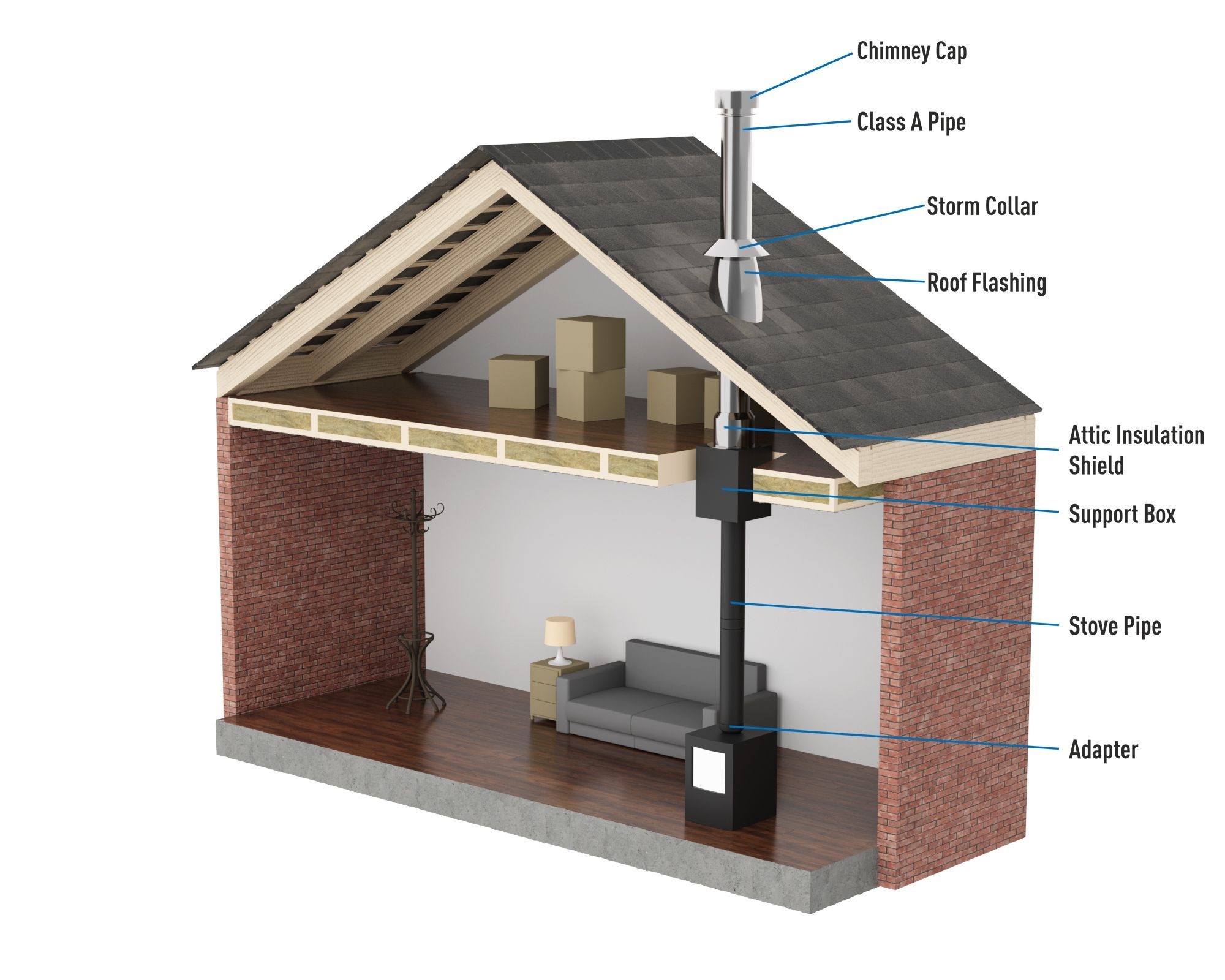
Connector pipe is the visible black pipe from the stove up to the ceiling, and it is the one part that must never pass through a wall, ceiling or roof. Single-wall connector pipe needs 18 inches of clearance to combustibles. Black double-wall connector pipe cuts that to 6 inches to a wall and 8 inches to a ceiling, which is why it is the usual choice in a tight room. Our guide on single-wall versus double-wall stove pipe sets out the trade-off.
Through the Building: Class A Insulated Chimney Pipe
The moment the flue passes through the ceiling, roof or an exterior wall, it must be Class A insulated chimney pipe. Ours is double-wall stainless with a 1.18 inch ceramic-fiber core, UL 103 HT listed, and rated for 1000 F continuous use. Class A insulated chimney pipe, when UL 103 HT-listed for wood-burning, maintains a minimum of 2 inches clearance to combustibles per the standard listing. Class A is priced by diameter and by the length of each section, and current prices for every length are listed on the Class A chimney pipe page.
The Transition and Support Parts of a Chimney
These are the parts people cannot name on a quote, and each one has a single job. Two get confused constantly: the roof flashing seals the hole in the roof, while the storm collar sits above it and clamps to the pipe so rain cannot run down the outside of the pipe into that seal.
| Part | What it does |
|---|---|
| Ceiling support box | Carries the weight of the chimney where it passes through the ceiling and holds the required clearance |
| Wall thimble | The insulated sleeve that lets the flue pass safely through a combustible wall |
| Tee with clean-out | Turns the run from horizontal to vertical outside and gives you a point to sweep from |
| Wall support bracket | Takes the weight of an exterior vertical run |
| Attic insulation shield | Keeps loose insulation off the pipe where it passes a cold attic floor |
| Roof flashing | Seals the roof penetration, matched to your roof pitch |
| Storm collar | Clamps above the flashing so rain cannot track down the outside of the pipe |
| Rain cap | Keeps water and debris out of the flue and helps the draft |
What Size Are These Parts
Size the whole system from the stove's flue collar, not from the room or the roof. Most US wood stoves use a 6 inch outlet. The live Class A system range also includes 8 inch, while the flexible liner categories are 5 and 6 inch. Size the complete run from the appliance listing, and keep the matched system at the required diameter; mixing brands, product families or sizes can invalidate the installation design.
Which Parts Does a Complete Kit Include
A complete kit gives you the matched set for one route: the Class A lengths, the ceiling support box or wall support, the flashing for your pitch, the storm collar and the rain cap. You choose the kit by the path the flue takes, through the roof, through the wall, or through an attic. Our systems are engineered as one certified assembly and are not designed to mix with other manufacturers' sections.
Relining a Masonry Chimney Instead
If the house already has a masonry chimney, the parts list changes: a flexible 316Ti stainless liner goes down the existing flue, with a tee or appliance connector at the bottom and a top plate and cap at the top. That is a chimney liner kit rather than a Class A system, and our guide to the types of chimney liner explains which one fits.
What Is the Thing at the Top of a Chimney Called?
The rain cap, and it is the part people most often ask about by description rather than by name. It sits at the very top of the flue and keeps water, leaves and animals out while still letting smoke away. Directly below it is the storm collar, which clamps to the pipe, and below that the roof flashing, which seals the hole in the roof. On a masonry chimney the equivalent top pieces are the crown and a separate chimney cap over each flue.
Two other names come up on quotes. The damper is the plate that opens and closes inside a masonry fireplace throat: it belongs to the fireplace, not to a stove pipe system, and a stove controls its own air instead. The flue collar is the round outlet on top of or behind the stove, and it is the measurement everything else is sized from.
Masonry Chimney or a Prefabricated One?
A masonry chimney is built on site from brick or block with a clay or stainless lining. A prefabricated chimney, which is what a Class A system is, arrives as certified factory-made sections that lock together. For a new wood stove the prefabricated route is the usual choice: it is a fraction of the weight so it needs no foundation, it goes up in a day rather than a week, and it comes UL 103 HT listed as a complete assembly, which is what an inspector wants to see. Masonry makes sense when you already have a sound chimney, and then the job is relining rather than building.
Is My Existing Chimney Suitable for a Wood Stove?
Check three things. The flue must be the right size for the stove outlet, and an old flue built for an open fire is usually far too large. The lining must be sound, with no cracked or missing clay tiles. And the chimney must reach the required height above the roof. If the size or the lining fails, a stainless liner solves both at once, which is why relining is the common answer rather than rebuilding.
Sizing, Codes, and the Mistakes Worth Avoiding
Size the chimney from the stove's flue collar, not from the room or the roof, and never reduce below it. For a fireplace rather than a stove the flue has to carry the full opening, so open fires commonly need 7 or 8 inch where a stove needs 6. On codes, per NFPA 211 (Standard for Chimneys, Fireplaces, Vents, and Solid Fuel-Burning Appliances), chimney installations must follow defined clearances to combustibles, minimum height above the roof penetration, and material requirements for the fuel type. Local codes typically adopt NFPA 211 by reference.
The installation mistakes we see most
- Running connector pipe through a wall or ceiling instead of transitioning to Class A.
- Mixing sections from different manufacturers, which voids the listing because the locking mechanism, insulation thickness and outer diameter all differ.
- Reducing the diameter somewhere in the run.
- Fitting the storm collar below the flashing rather than above it.
- Finishing the chimney too short, so it never drafts properly.
How Does Chimney Height Affect Performance?
Height drives the draft. A taller flue holds a larger column of warm rising gas, which pulls harder and gives a stove that lights easily and burns steadily; a run that finishes too low, or one that ends in the turbulent air behind a roof ridge, gives a weak or reversing draft and smoke in the room. That is why the height rules are about the surrounding roof line and not just the total length of pipe. Our chimney height guide gives the exact rule with worked examples.
How Often Should a Chimney Be Inspected and Cleaned?
Once a year, before the heating season, and more often if you burn hard or burn anything less than properly seasoned wood. The annual sweep clears creosote before it can build into a fire hazard, and the same visit is when a problem gets caught early.
DIY or a Professional
A capable homeowner can assemble a matched kit, and buying it as a kit turns the job from a design problem into a parts-list problem. For independent installation advice, use a licensed chimney contractor or a CSIA or NFI certified installer. Confirm the relevant product's limited warranty terms and installation requirements before you begin. Not sure which parts your layout needs? Our free flue-design service will build the exact list, or call our US team on 888-834-0880.
Need More Information?
- Chimney and stove pipe FAQ for clearances, temperatures and codes.
- Wood stove pipe installation guides for step-by-step help.
- Talk to our US technical team about your own layout.