Reviewed by Michael Janssen, Chemical Engineer (by training)
Short answer: use a chimney liner when you already have a masonry chimney and need to make the inside safe for a modern stove; use Class A insulated chimney pipe when there is no masonry chimney and you are building the vertical run yourself.
People mix these two up all the time, and it is easy to see why: both carry smoke, both are stainless steel, both end above your roof. The difference is what they run inside. One lines a brick shell you already own. The other is the shell.
The one-line difference
| Chimney liner | Class A chimney pipe | |
|---|---|---|
| What it is | A flexible stainless tube that drops inside an existing masonry chimney | A rigid, double-wall insulated stainless pipe that forms a complete new chimney |
| Use it when | You have a brick or block chimney and want to reline it for a wood stove or insert | You have no masonry chimney and need to build the run through a wall, ceiling, or roof |
| Installs into | The existing flue void | Open framing, then out through the roof or wall |
| Warranty | Limited Lifetime Warranty | 100% replacement for the first 15 years, then 50% of original price |
| Typical listing | UL 1777 (relining) | UL 103 HT (solid-fuel chimney) |
When you need a chimney liner 
If your home has an old masonry chimney, the clay tiles inside are often cracked, oversized for a modern stove, or simply worn out. A flexible stainless liner slides down that existing shell and gives you a smooth, correctly sized, sealed passage for the smoke. It is the standard fix when you are connecting a wood stove or insert to a chimney that is already built.
Sizing matters more than anything here: an oversized flue drafts poorly and lets creosote build. Our chimney liner sizing guide walks through matching the liner to your appliance, and the chimney liner kits come matched as one system.
When you need Class A chimney pipe
No masonry chimney? Then you are building one, and Class A insulated pipe is how a modern home does it. It is double-wall stainless with insulation between the layers, so the outside stays cool enough to pass safely through framing, ceilings, and the roof. This is what you use for a stove in a room with no existing chimney, a cabin, a workshop, or an addition.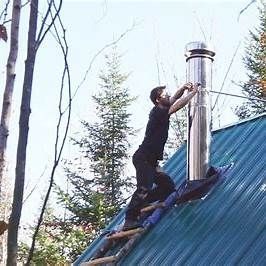
When Class A pipe is UL 103 HT-listed for wood-burning, it maintains a minimum of 2 inches clearance to combustibles per the standard listing. Always verify the exact clearance specified by the manufacturer's UL listing for the specific product. The Class A chimney pipe guide covers the full run, and the Class A chimney pipe range is sold in matched lengths.
Which is the lower-cost route?
Both routes save you real money against the old-fashioned alternative, and the savings come from the method, not from cutting quality.
- Relining beats rebuilding. Dropping a stainless liner into a sound masonry chimney costs far less than tearing out and rebuilding the brickwork, and a capable owner can do a standard reline as a DIY job.
- Metal Class A beats new masonry. Building a brand-new masonry chimney means a mason, materials, and weeks of labor. A metal Class A system is a fraction of that and goes up in a day or two. Real component pricing is public on the product pages: 6 inch Class A lengths start at $73, and 8 inch lengths start at $123, so you can price your exact run before you buy.
A standard install is genuinely DIY-friendly for a confident owner. If you would rather hand it off, a contractor can do the work; either way the warranty requires only that the system is installed according to the supplied instructions. For the full cost picture on the liner side, see our chimney liner cost guide.
Not sure which fits your home? We will design it, free
This is exactly the decision our specialists make every day. Tell us your stove and your layout and get free flue-design help: we spec the complete, code-compliant system you actually need, liner or Class A, so you are not guessing. You can also call us at 888-834-0880 and talk it through with a real chimney specialist.
Frequently asked questions
Can I use Class A pipe inside my old masonry chimney?
You would not normally need to. If the masonry shell is sound, a liner is the right tool. Class A is for building a run where no chimney exists.
Does a liner or Class A pipe last longer?
Both are built to last decades. Our chimney pipe lifespan guide breaks down the years by type.
Is the liner really warrantied for a lifetime?
The flexible stainless liner kit carries a Limited Lifetime Warranty. The Class A system is warrantied at 100% replacement for the first 15 years, then 50% of the original price after that.
Need More Information?
Visit our FAQ, browse the stove pipe installation guides, or check our technical advice section.