
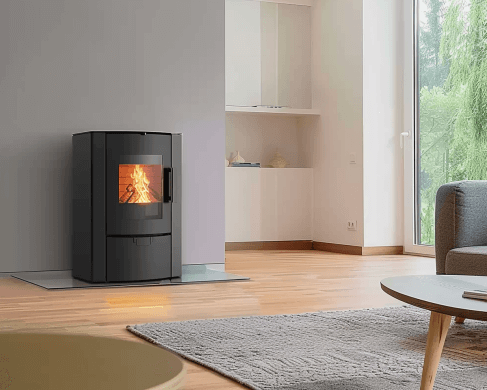
The short answer is no, you don’t need a chimney for your pellet stove. However, there’s more to it than that. This is one of the most common questions we get about pellet stove chimney arrangements.
Key Takeaways
- You don’t need a pellet stove chimney, but you must provide an escape route for the combustion fumes.
- Most people install pellet stoves with a balanced flue that runs to the outside, allowing fumes to escape without needing a chimney installation.
- If you have an existing chimney, you can connect some types of pellet stoves to it as a way to dispel the combustion gases.
- Because they don’t need a traditional chimney, pellet stoves are often far more versatile than other wood burners.
Do You Require a Wood Pellet Stove Chimney Installation?
No, you don’t! But you will need to install an exhaust system so that the combustion gases can exit the room. Let’s discuss the options.
Option 1: Using a Balanced Flue Installation
The most common way of installing a pellet stove exhaust pipe is to run a balanced flue from the stove’s exhaust to the exterior of your home or mobile home.

This is one of the easiest ways to vent gases since you can easily install this kind of exhaust pipe yourself. However, it’s important to bear in mind that your pellet stove vent pipe needs to be at least three inches from any combustible materials.
This option has certain advantages over other possibilities. For one thing, because these flues are sealed, they retain more heat than traditional alternatives. You’ll also find that these systems are incredibly efficient at keeping out drafts.
This type of setup has excellent efficiency ratings because it uses closed combustion systems. Additionally, a balanced flue setup is less likely to deplete the room's oxygen than certain types of stoves and exhaust systems.
Conventional Vs. Balanced Flue Pipes
So, what is the difference between a balanced flue pipe and a conventional one? The main difference lies in the application itself. In a balanced flue application, the unit is completely sealed. It still expels the combustion gases to the outside of the building, but it also draws the oxygen it needs through the flue.
In a conventional flue system, the combustion gases exhaust to the outside of the building, but the system draws oxygen from the inside of the building. This has several advantages, including a lower risk of oxygen depletion within the building.
If you want to link your pellet stove to a chimney flue and ensure that the system is balanced, look for a balanced appliance, which generally has a glass front. The sealed unit prevents air exchange with the room, forcing the system to operate via the flue.
Option 2: Placing the Pellet Stove in an Existing Space for a Fireplace
In homes or apartments with an existing chimney or space for a fireplace, it may be possible to place the pellet stove in the existing fireplace recess. You can then use a stove pipe and chimney flue pipe to connect the stove to the existing chimney.
Bear in mind that in some cases, you may have to install a chimney flue liner to make the chimney usable.
Benefits of Not Needing a Chimney for Your Pellet Stove
Are there any benefits to not needing a wood pellet stove chimney? Absolutely! It gives you several unanticipated benefits, including the following:
- Versatility and flexibility - Since pellet stoves don’t require a chimney, you can place them in far more places than a traditional wood burner.
- Use in mobile homes - Traditional wood burners are not approved for use in mobile homes in the UK. Pellet stoves are, thanks to their unique design.
- Ease of installation - Pellet stoves are much easier to install since they don’t require a full chimney. Using a simple flue pipe kit, you can easily run an exhaust for your device.
- Fuel versatility - Because none of the fumes enter your home, you can burn a wider array of fuels than in traditional alternatives.
Final Thoughts
Connecting your pellet stove to a chimney is optional, but it definitely isn’t a necessity. If you live in a home or apartment with a pre-built chimney, you may find this to be the simplest option. There isn’t a lot of work that goes into retrofitting an existing chimney with a chimney liner, and you can easily do it yourself in a day.
However, in many cases, newer buildings may not have chimneys. Pellet stoves are an ideal option. Due to their unique design, the flues for these stoves may be installed at much lower heights or even horizontally.
If you’re ready to install a chimney flue for your pellet stove, have a look at our twin wall flue kits. They’re easy to install yourself and incredibly affordable.


